

Peer evaluation
Group grades that hold up.
Students rate how their teammates actually contributed. Evenhanded turns those ratings into one defensible score per student — and quietly flags the free-riders, the score-inflaters, and the teams that split into camps.
Coming soon
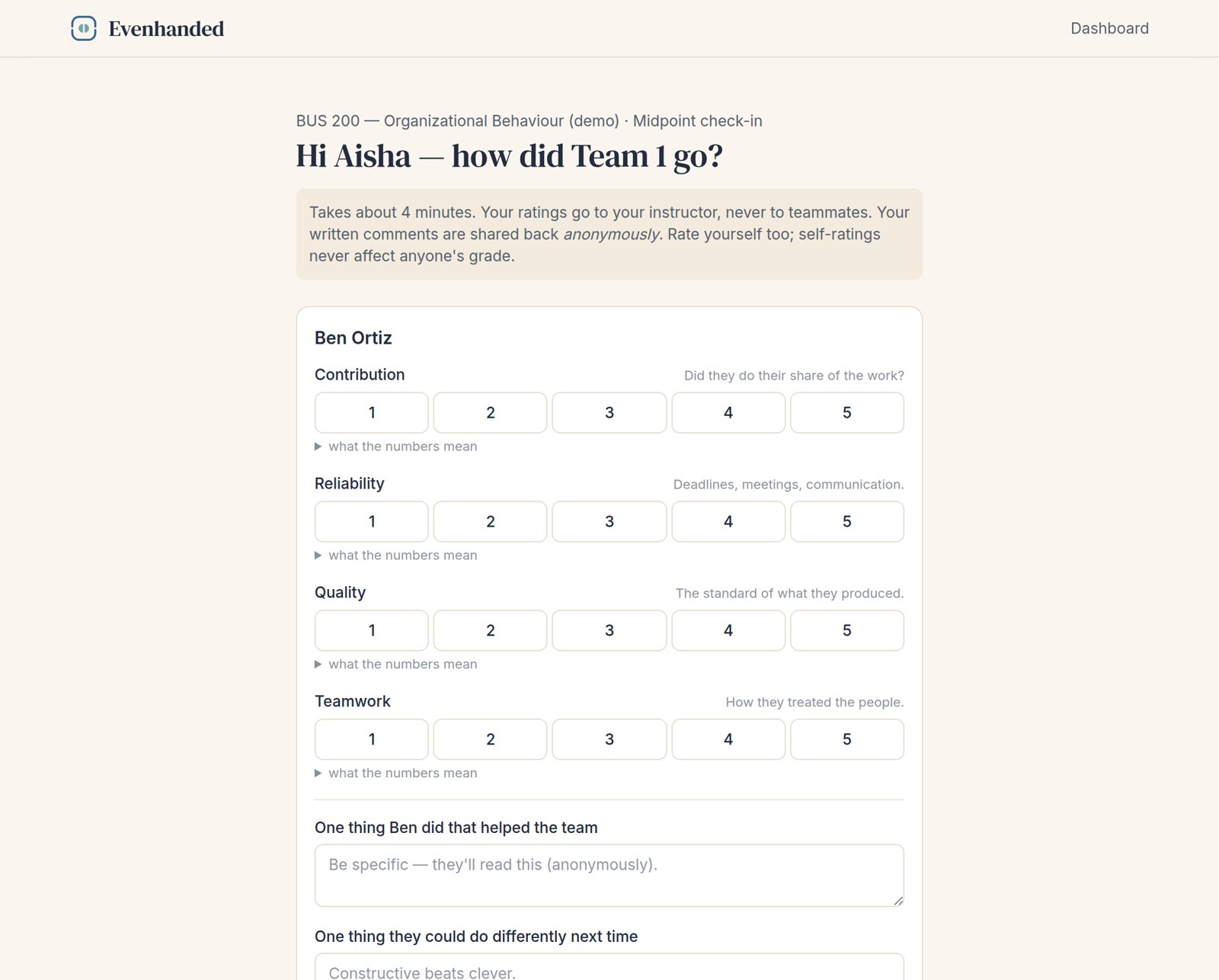
What students see — four quick dimensions, a comment or two, and a self-rating that never counts toward a grade.
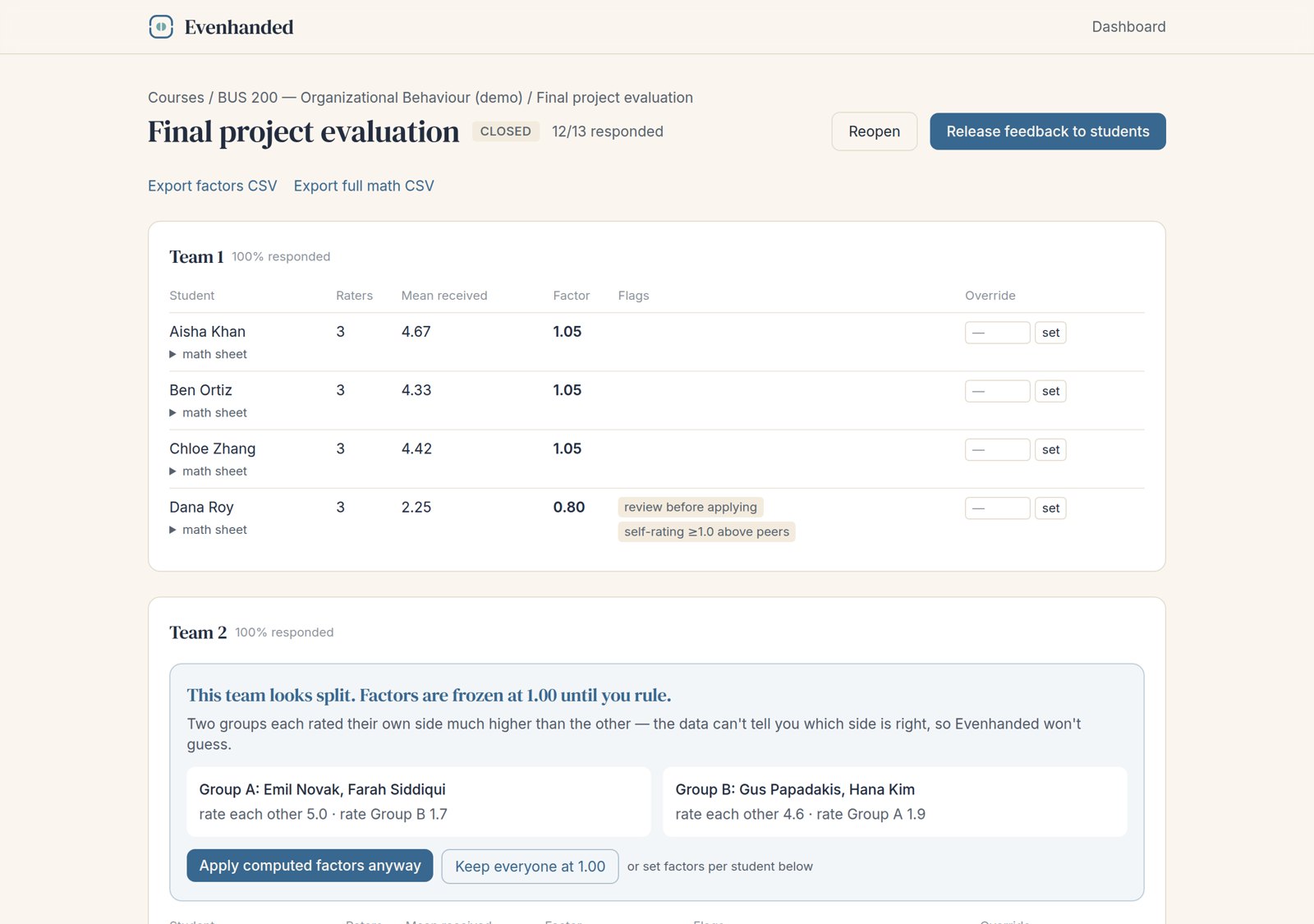
What you see — one defensible factor per student, with free-riders flagged and split teams frozen until you rule.
An interactive demo is coming soon.
What it does
- Fair by design. Four plain-language dimensions students actually understand. Self-ratings are collected, but they never count toward a grade.
- A number you can defend. Each student gets an adjustment factor from teammate ratings, smoothed so one outlier can't swing it, with a deadband so tiny differences don't move anyone's grade.
- Catches the hard cases. Free-riders, raters who score everyone the same, self-inflaters, conflict pairs, and 2-vs-2 team splits get surfaced automatically. Split teams freeze at neutral and hand the call back to you.
- Students see what helps. They read each other's comments — never their own factor — so feedback lands without blowing up the group.
- Private by default. No student logins to manage, nothing sold, nothing mined.
Pricing
Free for small classes. Cheap for big ones.
Instructor-paid, never student-paid. Runs on a personal card; covered by most teaching-development funds.
$1 per student after that — and it never costs more than $79 for a whole course.
How the scoring works
No black box. Here's the actual logic, because a grade you can't explain is a grade you shouldn't give.
Each student's teammates rate them on the four dimensions. Evenhanded averages those into a ratio against the rest of the team, then shrinks it toward neutral so a small team or thin data can't produce a wild swing. It applies a deadband — differences under a few percent round to no change — and caps the adjustment so nobody's grade gets destroyed or inflated past a sane range. With fewer than two raters, a student sits at neutral with a flag for you to look at.
When a team of four or more breaks into reciprocal camps — two people rating each other up and the other two down — the math steps back. That team freezes at neutral and you make the call with the ratings in front of you.
A privacy-first alternative to CATME-style peer assessment, priced for one instructor instead of a whole institution.
Made for group projects.
Evenhanded is coming soon. Leave your email and I'll tell you the day it's live.
Get notified →